
Jump to:
The 2026 ACSF Montréal Salon will gather architects, scholars, artists, and practitioners for a small-scale, site-based, and experiential exploration of architecture, embodiment, memory, and the sacred in urban life.
Departing from conventional conference formats, the Montréal Salon emphasizes walking, conversation, shared encounters, contemplative practices, workshops, and direct engagement with the city. Rather than formal podium presentations, the Salon will foster intimate discussion circles, participatory sessions, guided walks, meditative gatherings, and reflective experiences situated within Montréal’s layered architectural and cultural landscapes.
Montréal offers a particularly meaningful setting for this gathering. As a city shaped by powerful topography, history, and a unique blend of cultures, Montréal reveals visible and invisible layers of memory, ritual, atmosphere, and collective identity. The city itself becomes both host and participant in the Salon.
Situated on an island in the St. Lawrence River, Montréal occupies a territory shaped by movement, exchange, and encounter. Long before European settlement, Indigenous peoples inhabited the island for thousands of years; in 1535, Jacques Cartier encountered the St. Lawrence Iroquoians at Hochelaga, near the foot of Mount Royal. The later founding of Ville-Marie in 1642 added another layer to this longer history. These deep historical traces remain present in Montréal’s landscape, archaeology, sacred sites, and urban memory.
Enrollment will be intentionally limited in order to preserve the conversational and participatory character of the event.
The Montréal Salon invites participants to explore architecture as lived and embodied experience, where the body encounters the city not as an observer, but as a participant. Moving through streets, landscapes, sacred spaces, cemeteries, campuses, façades, gardens, and public rooms, we will engage forms in which we find an echo of ourselves: statues that hold a gesture, columns that stand like figures, thresholds that orient the body, trees that mirror architectural order, and spaces that invite movement, pause, and reflection. Between flesh and stone, perception unfolds in ways that are often pre-conscious, as sensation, memory, and emotion shape our understanding of place.
In this light, the built environment is not inert, but resonant: capable of reflecting, amplifying, and guiding human experience. The Salon will consider how architecture participates in embodied meaning through gesture, movement, orientation, storytelling, ritual, narrative, symbolic form, figure, affordance, materiality, proportion, resonance, light, ornament, and detail. Rather than approaching architecture only as object or image, we will attend to how it becomes meaningful through bodily presence, shared perception, and lived encounter.
Montréal offers an especially meaningful setting for such conversations. As a city of layered civic life shaped by French and English histories, Indigenous presence, Jewish heritage, and other rich religious and cultural traditions, Montréal holds visible and invisible realities together. Its architecture and urban landscapes reveal traces of memory, plurality, spirituality, cultural tension, and coexistence. The city itself becomes a living dialogue between tangible structures and intangible narratives.
The Salon asks participants to approach the city as a layered condition composed not only of streets, buildings, infrastructure, and measurable systems, but also of atmospheres, rituals, histories, symbolic forms, spiritual longings, and patterns of social life that often remain unseen yet deeply shape how place is experienced. Beneath the physical city exists an experiential city. Beneath what is visible and measurable lie intangible dimensions that influence belonging, identity, perception, and collective memory.
Through workshops, discussion circles, walks, meditative gatherings, and shared encounters, the Montréal Salon seeks to create space for reflection on how architecture and cities shape not only how we live, but how we perceive, remember, gather, and understand ourselves in relation to others and the world around us. Contributions are invited to slow down perception, activate attention, and reveal how architecture becomes meaningful through embodied engagement.
October 7 to 10 2026 | Times and meeting points remain subject to confirmation.
Sessions listed separately at the same time run concurrently.
Wednesday October 7 Arrival in Old Montréal
|
Time |
Program |
Venue |
|---|---|---|
|
2:00–3:00 pm |
Arrival and participant check-in |
Pointe-à-Callière (Montreal Museum of Archaeology and History) |
|
3:00–5:00 pm |
Museum visit |
|
|
5:00–6:30 pm |
Informal welcome and meet-and-greet |
Old Montréal |
Thursday October 8 Sacred space and shared inquiry
|
Time |
Program |
Venue |
|---|---|---|
|
8:00–9:00 am |
Arrival, meditation, and announcements |
Church of St. John the Evangelist (Red Roof Church) |
|
9:00-9:30 am |
Opening Conversation: The Salon, Its History and Spirit |
|
|
9:30–10:00 am |
Resonant Presence Act I: Sound, Body, and Architectural Encounter — Reza Assasi |
|
|
10:00–10:30 am |
Searching for the Transcendent in Sacred Space — Roberto Chiotti |
|
|
10:30–11:00 am |
Introduction to Mapping Atmospheres — Isabel Potworowski |
|
|
11:15 am–noon |
The Hidden and The Manifest: Exploring Architecture, Contemplation, and Sacred Awareness — Mani Ardalan Farhadi and Nooshin Esmaeili |
MEM |
|
How Informal Practices of Community Shape Public Space — Michelle Gagnon-Creeley and Narita Reyes Ico |
||
|
Noon–12:45 pm |
Access, Participation, and Belonging in Sacred Spaces — Moazima Rizwan |
|
|
Recovering in Place: From Disconnection to Reconnection — Victoria F. Burns and Nooshin Esmaeili |
||
|
12:45–1:45 pm |
Lunch |
|
|
1:45–2:45 pm |
Beyond Physical Access: Co-Creating Meaningful Contact — Mohammadmahdi Zanjanian, Fabian Neuhaus, Craig DeLean, and Sophie Symanczyk |
|
|
From “Give Me a Second” to “Give Me a Minute”: The Sanctity of Time in an Accelerated City — Fawaz Folakunmi Okunola |
||
|
2:45–3:30 pm |
Travel to Saint Joseph’s Oratory |
From MEM |
|
3:30–5:45 pm |
Architecture Beyond Vision: Bodily Friction and Mental Anticipation — Sepehr Younesnejad and Nooshin Esmaeili |
Saint Joseph’s Oratory |
|
Placeholding: An Embodied Methodology for Cultivating a Reciprocal Relationship with Place: A Workshop — Sarika Bajoria |
||
|
Mountain & Altar: Cosmic Symbolism in the Chapel and Apartment of Saint André Bessette — Stephane Gaulin-Brown |
Friday October 9 Embodiment city and conversation
|
Time |
Program |
Venue |
|---|---|---|
|
8:00–9:00 am |
Arrival, meditation, and announcements |
Church of St. John the Evangelist (Red Roof Church) |
|
9:00–9:45 am |
Resonant Presence Act II: Narrative, Memory, and the Afterlife of Place — Reza Assasi — (Guest Artist: Saeed Kamjoo) |
|
|
9:45–10:30 am |
From Body to Place: Reawakening Embodied Perception in Design — Rachael Grochowski and Nooshin Esmaeili |
|
|
10:30–11:15 am |
Break and travel to MEM |
Red Roof Church to MEM |
|
11:15 am–noon |
Carrying the Sacred: Architecture, Embodied Presence, and the City — Reza Assasi |
MEM |
|
Barzakh: Threshold, Cosmology, and the Sacred in the Mundane City — Ali Salama |
||
|
Noon–12:45 pm |
Mapping Atmospheres — Isabel Potworowski |
|
|
A Site-Specific Participatory Ritual — Odudu Umoessien |
||
|
12:45–1:45 pm |
Lunch |
|
|
1:45–2:30 pm |
Featured conversation with Alberto Pérez-Gómez |
|
|
2:30–2:45 pm |
Closing at MEM |
|
|
2:45–4:45 pm |
Guided Old Montréal walking tour |
Begins at MEM; ends near Notre-Dame Basilica |
|
4:45–5:45 pm |
Drawing, Seeing and the Spirit of Place: A Workshop in Contemplative Observation — John P. Blood and Elizabeth Danze |
Notre-Dame Basilica |
|
6:00–7:00 pm |
Notre-Dame Basilica and AURA experience |
|
|
7:00–9:00 pm |
Salon group dinner |
3 Brasseurs Saint-Paul, Old Montréal |
Saturday October 10 Mount Royal and informal exploration
|
Time |
Program |
Venue |
|---|---|---|
|
9:00–11 am |
Scale: The Ecotone of the Natural and Urban — Sam Padron Hernandez |
McGill Campus and Park Mount Royal |
|
11:00 am–noon |
Continued Mount Royal exploration and closing reflections |
Mount Royal area |
|
After noon |
Informal city explorations, and departures |
At participants’ discretion |
Pointe-à-Callière (Montreal Museum of Archaeology and History) — 350 Place Royale, Montréal
Church of St. John the Evangelist (Red Roof Church) — 137 President Kennedy Avenue, Montréal
MEM – Centre des mémoires montréalaises — 1210 Saint-Laurent Boulevard, Montréal
Saint Joseph’s Oratory — 3800 Queen Mary Road, Montréal
Notre-Dame Basilica — 110 Notre-Dame Street West, Montréal
3 Brasseurs Saint-Paul — 105 Rue Saint-Paul E, Montréal
Download Montréal Salon program here.
Anticipated Registration Fees
Full Salon Registration — USD 275 (approx. CAD 375)
Includes:
Two-Day Pass — USD 150 (approx. CAD 200)
Includes:
Excludes:
Accommodation and transportation are not included.
Salon Venues: MEM and the Church of St. John the Evangelist
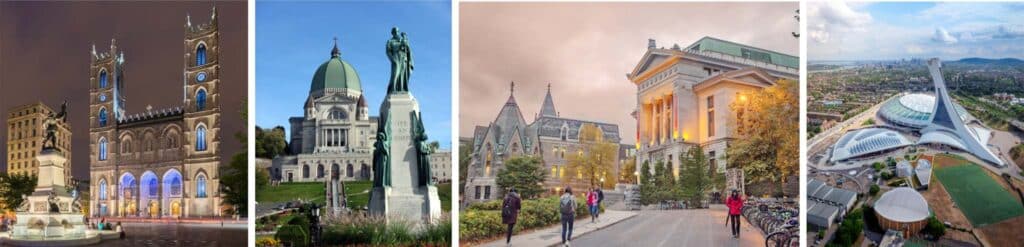
Salon activities will be anchored by venues that reflect Montréal’s civic and spiritual layers. MEM – Centre des mémoires montréalaises will serve as the main setting for discussion circles, workshops, catered lunches, and shared reflection. As a museum dedicated to Montréal’s collective memory and lived urban experience, MEM aligns closely with the Salon’s interest in the visible and invisible dimensions of the city. The Church of St. John the Evangelist is being considered as a contemplative venue for morning meditation, poetry, and meditative music. Together, these venues frame the Salon between civic memory and sacred atmosphere.
Museums and Cultural Institutions
Montréal’s museums offer rich opportunities to connect architecture, memory, archaeology, art, and urban culture. Potential visits may include Pointe-à-Callière / Montréal Museum of Archaeology and History, located on the birthplace of the city; the Montréal Museum of Fine Arts, with its important collections and architectural campus; the Museum of Contemporary Art, reflecting Montréal’s contemporary cultural life; and the Canadian Centre for Architecture (CCA), one of the world’s leading institutions for architectural research, exhibitions, and public discourse. Together, these institutions help situate the Salon within Montréal’s broader cultural and intellectual landscape.
Old Montréal
Old Montréal offers one of the richest urban settings in North America for exploring architecture, memory, and embodied experience. Its streets, squares, churches, stone façades, and layered public spaces reveal the city’s colonial, mercantile, religious, and civic histories. Walking through Old Montréal allows participants to encounter the city through scale, material, rhythm, threshold, and atmosphere.
Notre-Dame Basilica
Notre-Dame Basilica is one of Montréal’s most significant sacred interiors. Its dramatic use of light, colour, ornament, and spatial sequence offers a powerful setting for considering how architecture shapes awe, ritual, memory, and collective experience. The Basilica also provides an opportunity to reflect on the relationship between sacred tradition, public culture, and contemporary immersive media.
Saint Joseph’s Oratory
Saint Joseph’s Oratory is one of Montréal’s major pilgrimage sites and one of the city’s most visible sacred landmarks. Situated on Mount Royal, it combines monumental architecture, devotional practice, landscape, and bodily ascent. The site invites reflection on pilgrimage, healing, prayer, scale, and the relationship between sacred architecture and topography.
Mount Royal and Mount Royal Cemetery
Mount Royal is central to Montréal’s identity, both physically and symbolically. Its landscape, paths, views, and seasonal atmosphere offer a powerful setting for walking, reflection, and embodied encounter. Nearby, Mount Royal Cemetery offers a contemplative landscape where architecture, monument, memory, inscription, nature, and mortality intersect.
McGill University and the Academic City
Montréal is home to four major universities—McGill University, Université de Montréal, Concordia University, and UQAM—making it one of Canada’s most important academic cities. McGill’s historic campus, located at the foot of Mount Royal, offers a rich setting for considering architecture, education, landscape, and institutional memory. The city’s university culture also supports the Salon’s broader dialogue between scholarship, pedagogy, design, and public life.
Plateau Mont-Royal
The Plateau offers a vivid experience of Montréal’s everyday urban life. Its walkable streets, exterior staircases, murals, cafés, neighbourhood parks, and dense residential fabric reveal a human-scaled city shaped by social life, artistic culture, and daily movement. It provides a contrasting but equally meaningful lens on embodiment, dwelling, and urban atmosphere.
Temple Emanu-El-Beth Sholom
Temple Emanu-El-Beth Sholom contributes an important Jewish and modern architectural layer to the Salon’s exploration of Montréal’s sacred and cultural landscape. Its modernist architectural language, façade, and interior space offer an opportunity to reflect on continuity, adaptation, ritual, and the architectural expression of religious community in the modern city.
Modern Montréal: Habitat 67, Westmount Square, Place Bonaventure, and Olympic Legacy
Montréal’s modern architecture offers a powerful counterpoint to its historic and sacred landscapes. Habitat 67 by Moshe Safdie, Westmount Square by Mies van der Rohe, Place Bonaventure, the Olympic Stadium, and the Biosphere by Buckminster Fuller reveal Montréal’s ambitious twentieth-century architectural imagination. These sites invite reflection on modernity, dwelling, abstraction, infrastructure, ecology, and the changing relationship between architecture and urban life.
Underground City and Metro System
Montréal’s underground city and metro system offer a distinct form of embodied urban experience. These interior networks shape movement, orientation, weather protection, and everyday life, creating another layer of the city beneath its streets. They provide a useful counterpoint to the Salon’s outdoor walks, sacred spaces, and historic urban fabric.
Arts, Dance, Music, and Performance Culture
Montréal is widely recognized for its vibrant cultural life, including contemporary dance, music, theatre, visual art, festivals, and experimental performance. These traditions are deeply connected to the Salon’s interest in embodiment, movement, atmosphere, and shared experience. The city’s performance culture offers an important lens for understanding architecture not only as built form, but as a setting for gesture, rhythm, gathering, ritual, and collective imagination.
Montréal is highly walkable and accessible through public transportation.
Access
Accommodation
Participants will arrange their own accommodations.
Options include:
The submission period for Discussion Circles and Workshops has ended.
Salon Presenters and ACSF members will be notified about available spaces and how to register.
May 31, 2026: Call for submissions and participation opens
July 15, 2026: Circle and Workshop Proposal submission deadline
August 1, 2026: Peer Review process complete.
August 5, 2026: Feedback sent (approval/rejections known).
September 1, 2026 Deadline to confirm author participation and registration.
September 21, 2026: Final text of Circle/Workshop submission deadline (for e-publishing)
October 7-10, 2026: ACSF Montreal Salon held
For questions about the Salon, please contact Reza Assasi at assasi@acsforum.org