Sarika Bajoria
Contemplative Designer, Parsons School of Design, New York, NY, USA
email: sarika@contemplativedesigner.com
Keywords: practice, design; spirituality, sacred space, contemplation; empathy, compassion; growth, transformation; phenomenology; workshop
Introduction
How might we cultivate the capacity to enter into relationship with a place before beginning to intellectually engage with it?
Whether as architects, designers, scholars, or simply inhabitants of the built world, our encounters with place are often shaped by unconscious habit. We move through physical environments that can recede into passive backgrounds rather than emerge as living protagonists. This workshop introduces Placeholding, an embodied methodology developed within the Contemplative Designer Framework that cultivates multisensory attunement, radical wonder, empathic imagination, and reciprocal dialogue with place. While especially relevant to architects and designers seeking more humane and relational ways of understanding context before intervention, Placeholding holds value for anyone who wishes to cultivate deeper presence, belonging, and relationship with the built world.
Drawing on James J. Gibson’s ecological approach to perception, Maurice Merleau-Ponty’s embodied phenomenology, Juhani Pallasmaa’s conception of architectural experience as an intertwining of consciousness and the world, and Louis Kahn’s invitation to enter into conversation with materials, Placeholding encourages dynamic engagement between person and place rather than detached observation. Merleau-Ponty asked “How would the painter or poet express anything other than his encounter with the world?” This workshop extends that question: “How might we create anything other than that which reflects our encounter with place?”
Encountering Saint Joseph’s Oratory
Designed to complement the Salon’s planned visit to Saint Joseph’s Oratory, one of Montréal’s most significant sacred landscapes, the workshop offers a distinctive way of engaging this site through Placeholding, a guided experiential and contemplative encounter with architecture, landscape, and the city. Rather than learning about the Oratory, participants are invited to learn with it, allowing its materiality, changing light, landscape and silence to become active partners in perception. The Placeholding component is intentionally modular, occupying only part of the shared visit so that participants retain time to encounter the basilica, crypt, church, grounds, and other areas of the Oratory.
We begin with a Wonder and Empathy Walk, where participants will become attuned to the dialogue between body and environment while moving through the Oratory’s pathways and architectural thresholds. Rather than privileging vision, the full multisensory richness of the place—changing qualities of light and shadow, texture, sound, smell, materiality and felt emotional resonance – will be tapped into. This embodied attunement cultivates the capacity to receive a place through one’s whole being before seeking to interpret or evaluate it.
Next, with the playful practice first contact listening like an Alien Designer, participants will suspend familiar modes of perception and instead encounter every threshold, wall, stone, shaft of light, and design element as if for the very first time, not as inert but as living presences possessing history, character, and expressive voice.
Building on this embodied encounter, participants engage a condensed Love Letters practice. On site, they briefly compose a response either to the Oratory—expressing what has been received through their encounter—or imaginatively from the Oratory, allowing the place to speak through its materiality, atmosphere, memory, light, and presence. Participants may accompany the response with a quick sketch, photograph, or other visual notation that gives form to the sensory and relational qualities of the experience. The fuller Reciprocal Love Letters practice—composing both a letter to and a letter from the place, accompanied by a visual embodied expression—will be offered as an optional continuation after the site visit.
The facilitated encounter concludes with a short Salon Circle in which participants may share excerpts or visual impressions and reflect collectively on how their perception shifted from detached observation toward embodied relationship. Together we consider how Placeholding might enrich design education, practice and our everyday relationships with the places we inhabit.
Why Placeholding?
Our conscious lives are spent “in place”. Placeholding is intended as a repeatable methodology for cultivating the human capacities through which meaningful relationships with places become possible. For architects and designers, these capacities can support more sensitive understanding of context before intervention and help translate authentic embodied and imaginative encounters into design process and practice. For everyday inhabitants, Placeholding offers a simple way to recognize how the spaces they inhabit can become active participants in their flourishing through a simple shift in perception.
Proposed Modular Sequence : 40- 45 minutes within the shared 90 minute Saint Joseph’s Oratory Visit
- 7 minutes: Orientation, grounding, and introduction to Placeholding. Distribute workshop guide and materials.
- 15 minutes: Wonder and Empathy Walk + First Contact Listening like an Alien Designer
- 10 minutes: Condensed Love Letter writing to or from the Oratory and/or visual expression.
- 5–10 minutes: Salon Circle: Voluntary sharing and collective reflection.
Optional Continuation
The complete Reciprocal Love Letters exercise—one letter to the Oratory and one letter from the Oratory, accompanied by a visual embodied expression—will be provided as an optional post-visit reflection rather than requiring extended quiet writing time on site.
Materials / Supplies
- One-page Placeholding guide with prompts, provided by the facilitator.
- Writing/drawing materials by participants or provided/coordinated by the facilitator.
- Participants may optionally use a smartphone/camera for reflective photography.
Coordination Preference
The Placeholding component can be scheduled sequentially with the other Oratory workshop or adapted for subgroups. Final sequencing should preserve sufficient time for independent exploration of the Oratory and will be coordinated with the other site-based presenter.
References
Chandavarkar, Prem. “Wonder, Wisdom, and Mastery in Architecture.” In Architecture, Culture, and Spirituality, edited by Thomas Barrie, Julio Bermudez, and Phillip James Tabb, 211–220. New York: Routledge, 2015
Gibson, James J. The Ecological Approach to Visual Perception. Boston: Houghton Mifflin, 1979.
Kahn, Louis I. Between Silence and Light: Spirit in the Architecture of Louis I. Kahn. Edited by John Lobell. Boulder, CO: Shambhala, 1979.
Merleau-Ponty, Maurice. “Eye and Mind.” In The Merleau-Ponty Aesthetics Reader: Philosophy and Painting, edited by Galen A. Johnson, 121–149. Evanston, IL: Northwestern University Press, 1993.
Pallasmaa, Juhani. The Eyes of the Skin: Architecture and the Senses. 3rd ed. Chichester, UK: Wiley, 2012.
Pallasmaa, Juhani. “The Aura of the Sacred.” In The Religious Imagination in Modern and Contemporary Architecture: A Reader, edited by Renata Hejduk and Jim Williamson. New York: Routledge, 2011.
Site Confirmation
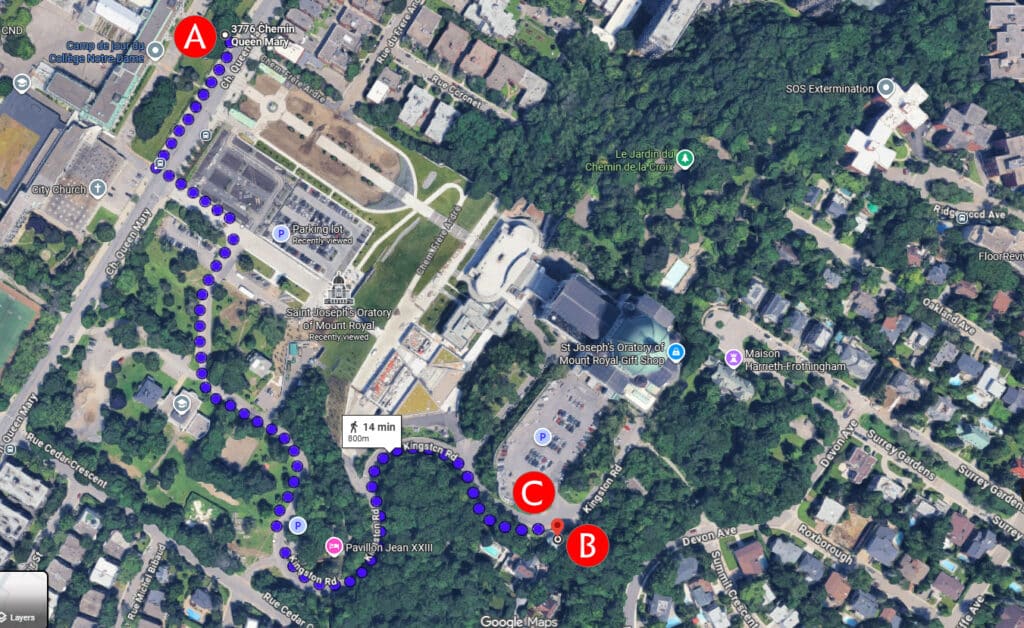
Direct coordination with Saint Joseph’s Oratory has been initiated to confirm group permission/reservation requirements, the precise route and meeting point, a quiet writing/discussion area, October construction conditions, capacity, accessibility, restrictions on writing/sketching/photography, and an inclement-weather option. These site-specific details will be provided to ACSF as soon as confirmation is received from the Oratory.
Author Bio
Sarika Bajoria is the founder of Contemplative Designer, principal of the design practice Sarika Bajoria Unlimited, and an adjunct professor at Parsons School of Design and the University of New Haven. She created the Contemplative Designer Framework—an evidence-informed design methodology, pedagogical framework, and emerging contemplative epistemology that draws on architecture, contemplative science, neuroaesthetics, embodied cognition, and the science of human flourishing to cultivate designers’ capacities for empathic imagination and meaning-making. Her work explores how these inner capacities transform creative practice, perception, and ways of knowing, ultimately shaping more humane, meaningful, and life-affirming environments. Sarika currently leads a multidisciplinary research program investigating the framework’s impact on design education, creative practice, design outcomes, and designer well-being. Through workshops, lectures, and keynote presentations, she shares contemplative approaches that expand how designers perceive, relate to, and create within the built environment. A Building Design+Construction 40 Under 40 and ENR New York 20 Under 40 honoree, Sarika previously served as the Founding Director of Architecture for Humanity New York. She is a Lighthouse Fellow with the Center for Conscious Design (CCD) and serves on the Board of Directors of the Architecture, Culture, and Spirituality Forum (ACSF). She holds a Master of Architecture from the University of Pennsylvania and a BA in Physics, Mathematics, and Art from Luther College.