Samuel Padron Hernandez
University of Calgary | Calgary, AB | Canada
samuel.hernandez@ucalgary.ca
Philosophy | Spirituality | Design | Contemplation | Sanctuary | Phenomenology | Connection
Date: Saturday, October 10th, 2026
Time: 90 minutes
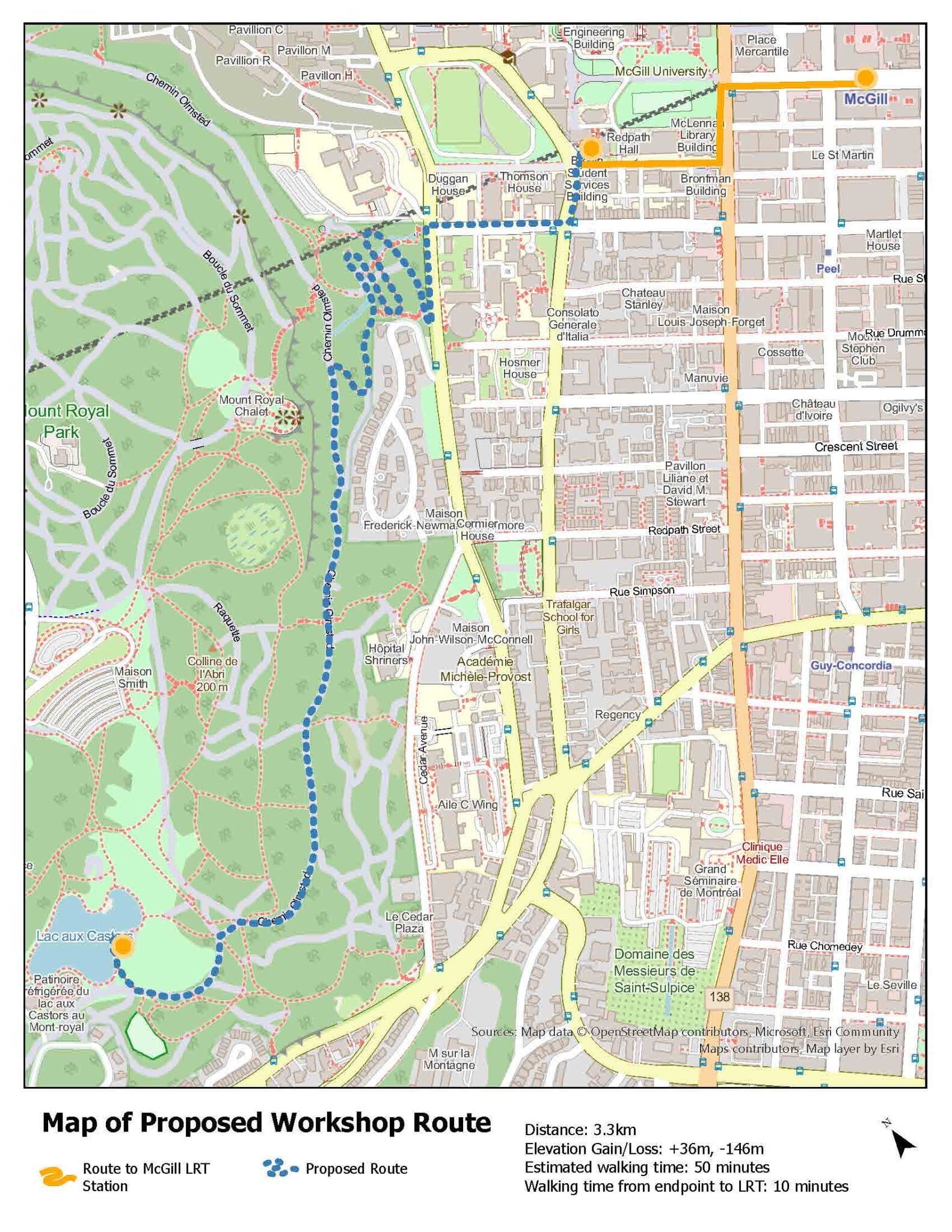
Location: Mount Royal Park 🡪 McGill University Leacock Building (see route plan on separate file)
An ecotone is a transitional area where two (or more) ecosystems meet, blend, and interlock to form a new, resource-rich, and high-potential zone. These areas tend to have higher density of flora, fauna, and they feature a large mix of them too. The city of Montreal is not unlike this, and the result of the blending of its natural space with the urban elements are a testament to the culture, tradition, and spiritual mentalities of the people which have come to inhabit the city.
As Montreal is rich in said diversity, it has drawn in many ideas and experiences in one large and varied space. To understand the “ecotone” of Montreal and its effects, a closer look at the interactions between people, nature and the built environment will be taken. The workshop will take the participants through a walk in Mount Royal Park in a narrative that expands from a small-scale, nature-based experience to a large-scale, city-based lens. To accomplish this goal, small activities and discussions will be made to engage the participants within the “ecotones”, along with the telling of city histories along the walk. Booklets will also be given out with reflective questions for the intention of self-discovery within the context of the walk, and for future keeping. With preliminary emphasis on observation, participants will have the opportunity to interact and integrate with the city’s natural, urban, religious, and cultural elements.
A central discussion topic will revolve around the idea that as people, we are spiritual in nature, and we seek constant connection and understanding of the world around us. From this, one main question can be posed to the individual: “Who am I to the ecotone?” The ways in which people affect it and how it affects people is a topic of differing scales and lived experiences. The shift from nature to urban in both time and space can help explain this desire to know purpose and find community: the history seen in the First Nation tribes, colonial settlements, and religious and social circles today are reflections of this desire within us all. Yet, in all these social gatherings, there is a real and tangible mental, spiritual, and physical rejuvenation in finding oneself near the natural elements we have grown alongside and moved on from. It stands to reason that in the big city; despite being connected with others, it is a busy place that cannot provide the therapeutic benefits of solitude found within nature. Loneliness can often be found in the most populated places. Following this line of thought, an exploration of how this natural-urban boundary affects everyone: what elements of the natural add to or detract from our lived experience in the city? What elements of the city affect that of the natural and its constituents?
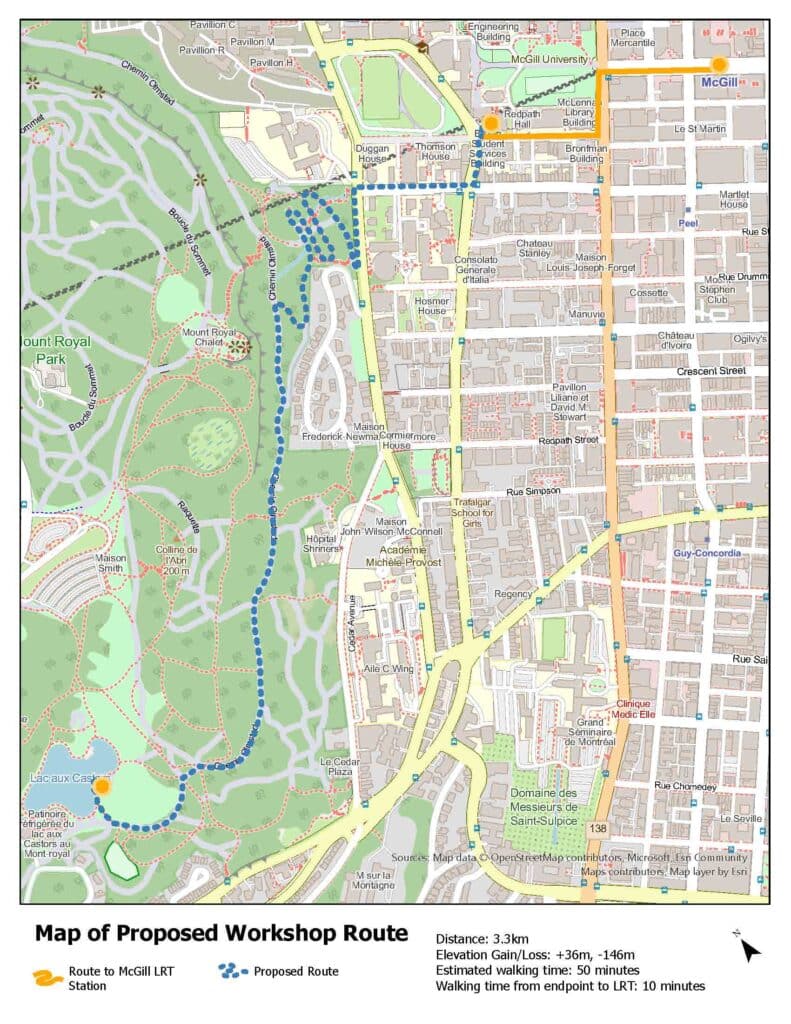
On the walk, a transition from small-scale nature observations to a large-scale analysis of city elements will support the talking points of what drives an individual’s spirituality, the effects of nature on the urban (and vice versa), and the impacts and creation process of a well-designed space which people inhabit. Following the Olmsted Trail, a well maintained and paved pathway, the walk is made easily accessible for participants of all backgrounds. Alternate paths will be provided on a map in the booklet provided if participants wish to split off and rejoin the group at a given moment, or if the group is determined to be fit enough to traverse them. Starting at the Beaver Lake Fountain, the group will do a small icebreaker activity before heading down the Olmsted Trail and ending at McGill University’s Leacock Building amphitheater.
Logistics
- The walking path takes approximately 50 minutes to complete. This leaves 40 minutes for resting/activity/discussion time throughout the walk.
- Participants will be required to be at the Beaver Lake Fountain in Mount Royal Park at 0800h on Saturday, Oct. 10th, 2026. The proposed route will end at the McGill University Leacock Building’s amphitheatre.
- The endpoint is a 10-minute walk from McGill Underground LRT Station, where participants can take transit to travel to their next destination at either Saint Jean Baptiste (20-minute transit ride) or Little Italy (20-minute transit including switch to orange line at Berry-UQAM Station).
- Restrooms are available at the Beaver Lake Pavilion and the Mount Royal Chalet.
- Participants will be advised to bring weather-appropriate clothing (rain jacket, snow coat) and good walking shoes.
- Participants should bring a notebook and a pen.
- For best method of contact, my phone number will be available to the participants of the workshop.