Sepehr Younesnejad
University of Calgary, School of Architecture, Planning + Landscape (SAPL), Canada
sepehr.younesnejad@ucalgary.ca
Nooshin Esmaeili
University of Calgary, School of Architecture, Planning + Landscape (SAPL), Canada
nooshin.esmaeili@ucalgary.ca
Keywords: Workshop, sacred space, monastery, phenomenology, ritual, transcendence
What if architecture could quiet the mind by first engaging the body?
This experiential workshop invites participants to encounter Saint Joseph’s Oratory as an active kinesthetic landscape, exploring how movement, bodily effort, anticipation, and architectural thresholds shape our state of mind and prepare us for contemplation. Moving from the base of the Oratory to the sanctuary, participants will investigate a central proposition: the physical resistance and rhythm of an architectural journey can gradually quiet everyday “mental noise,” heighten awareness, build anticipation, and prepare the body and mind for contemplative experience before the final threshold is crossed.
Rather than observing the Oratory only as an architectural object, participants will experience it through their own bodies, through movement, fatigue, rhythm, sensation, pause, and anticipation.
The Experience
Participants will be given a standardized “Friction Scorecard”. As the group ascends the Oratory in complete silence, they will pause for five seconds at five specific architectural checkpoints (The Base, The Mid-Landing, The Plaza, The Vestibule, The Sanctuary) to map their somatic and mental states.
At each threshold, participants will map two variables:
- Mental Noise: Measuring the presence in the moment and distraction, presence of mundane daily thoughts and anxieties (1 = Completely present; 5 = Highly distracted).
- Bodily Effort: Measuring physical resistance, muscle fatigue, and environmental friction
(1 = Effortless; 5 = Maximum exertion).
By tracking mind and body simultaneously, participants will create a personal map of how architectural movement, physical effort, sensory experience, and spatial transition influence attention and contemplation.
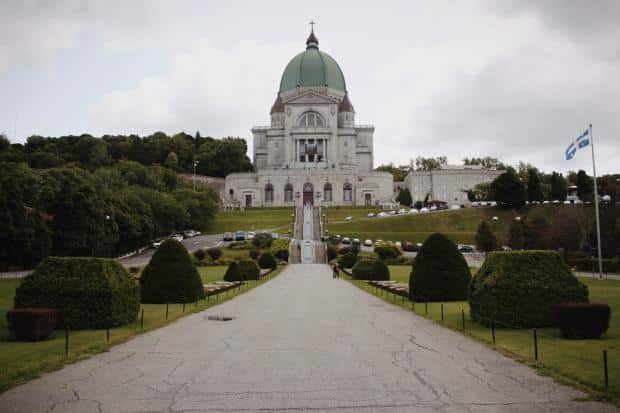
Figure 1: The central approach to the Oratory. Photograph by Jonathan Cha, 2014, © Ville de Montréal.
The Journey as Method
The workshop is structured as a gradual sequence of movement, effort, pause, and transition. Rather than treating each threshold as an isolated moment, participants are invited to experience the ascent as a continuous architectural journey in which each stage builds upon the last. The Friction Scorecard is not intended to measure performance or produce a “correct” response. Instead, it acts as a simple tool for making subtle changes in bodily and mental states more visible. As participants move upward, the relationship between physical effort, mental noise, sensory awareness, and anticipation may shift, sometimes gradually, sometimes unexpectedly. The aim is to become attentive to these changes without trying to force them. What happens to the mind as the body works? What happens to our perception of architecture as arrival is delayed? And how does crossing a threshold feel when the body has already experienced the journey leading to it?
Phase 1: The Cognitive Baseline & The Anticipation (5 Minutes | Base of the Stairs)
Gathering at the base of the exterior stairs, participants are asked to identify specific mundane thoughts, daily stressors, and scheduling conflicts currently occupying their minds to establish a “cognitive baseline.” Then they are given a secular “Pilgrim’s Intent”: an anticipation of the profound moment of sensory stillness and spatial release that awaits them at the summit. The group is briefed on the scorecard and instructed to begin the ascent in silence.
Phase 2: The Ascent & Awareness (20 Minutes | The Approach)
As participants ascend the pilgrimage steps, they pause at designated thresholds to record their levels of Mental Noise and Bodily Effort on their scorecards. They are encouraged to pay strict attention to sudden haptic shifts, a gust of wind, the physical weight in their legs, etc.
Accessibility & Somatic Variance: There is no “correct” level of effort. Bodies encounter architecture differently. For seniors, individuals with limited mobility, or those managing injuries, the architectural friction will register much higher, much faster. Participants who require more time are encouraged to do so and note these conditions on their cards. The exercise maps their personal shift in somatic exertion, not an objective able-bodied baseline.
Phase 3: The Point of Release (5 Minutes | Entering the Sanctuary)
Crossing the final threshold into the main contemplative space would be the final data-gathering point. Participants are prompted to check back in with the mundane thoughts they identified at the base of the stairs to observe how the journey altered their weight. Then, they reflect on the anticipation: did the sheer effort of the sequence add a deeper sense of meaning and presence to this final room than if they had simply stepped out of an elevator?
Phase 4: Synthesis & Discussion (15–20 Minutes | Inside the Oratory)
The group gathers to connect the dots on their scorecards, overlaying their “Mind” and “Body” graphs. We will use this visual data to anchor a collective discussion.
- How does architecture choreograph attention?
- Can physical effort deepen our awareness of place?
- What role does anticipation play in contemplative experience?
- Can thresholds and transitions help move us from distraction toward presence?
- And how might architects intentionally design journeys, not only destinations, that support reflection, meaning, and wellbeing?
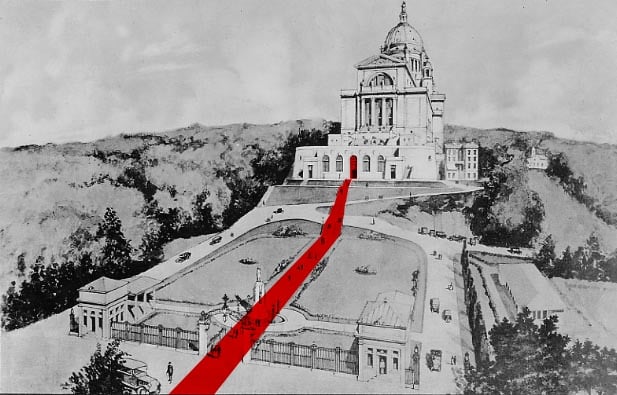
Figure 2: kinesthetic friction along the entry sequence. Base architectural plan by Viau et Venne, 1924. Source: Archives de l’Oratoire Saint-Joseph, © Oratoire Saint-Joseph du Mont-Royal. Graphic overlays by author.
Embodied Reflection
Through this shared embodied inquiry, Saint Joseph’s Oratory becomes not simply the setting for the workshop, but an active participant in it. Ultimately, this workshop proposes that contemplation does not begin at the sanctuary; it begins with the journey toward it. The stairs, pauses, thresholds, bodily effort, changing sensations, and anticipation of arrival are not simply obstacles to overcome; they are architectural instruments that gradually reshape attention. By engaging the body first, architecture may create the conditions for the mind to become quieter, more present, and more receptive. At Saint Joseph’s Oratory, the ascent reveals a powerful possibility: architecture can choreograph a transition not only through space, but through states of being, transforming movement into awareness, effort into presence, and arrival into a deeply felt experience.
References
Pallasmaa, Juhani. The Eyes of the Skin: Architecture and the Senses. Chichester: Wiley, 2005.
Relph, Edward. Place and Placelessness. London: Pion, 1976.
Sinclair, Brian R., and Nooshin Esmaeili, eds. Health, Happiness, Design, and the City: Explorations of Critical Forces & Factors Beyond the Pragmatic. Calgary, Canada: Calgary Quality in Canada Built Environment, 2026.
Sinclair, Brian R., and Nooshin Esmaeili. “Design Quality Reset: Interrogating Definition, Delineation, Measurement + Meaning in a Shifting Ethos.” In Advances in Architecture, Urbanity + Social Sustainability, vol. XII, 27–35. Symposium paper, Azrieli School of Architecture and Urbanism, Carleton University. Baden-Baden, Germany, and Ottawa, Canada: International Institute for Advanced Studies in Systems Research and Cybernetics, 2022.
Tuan, Yi-Fu. Space and Place: The Perspective of Experience. Minneapolis: University of Minnesota Press, 1977.