Ali Salama
Oakville, ON, Canada
ali.salama@uwaterloo.ca
Keywords: theory, philosophy, sacred space, architecture, discussion circle
Introduction
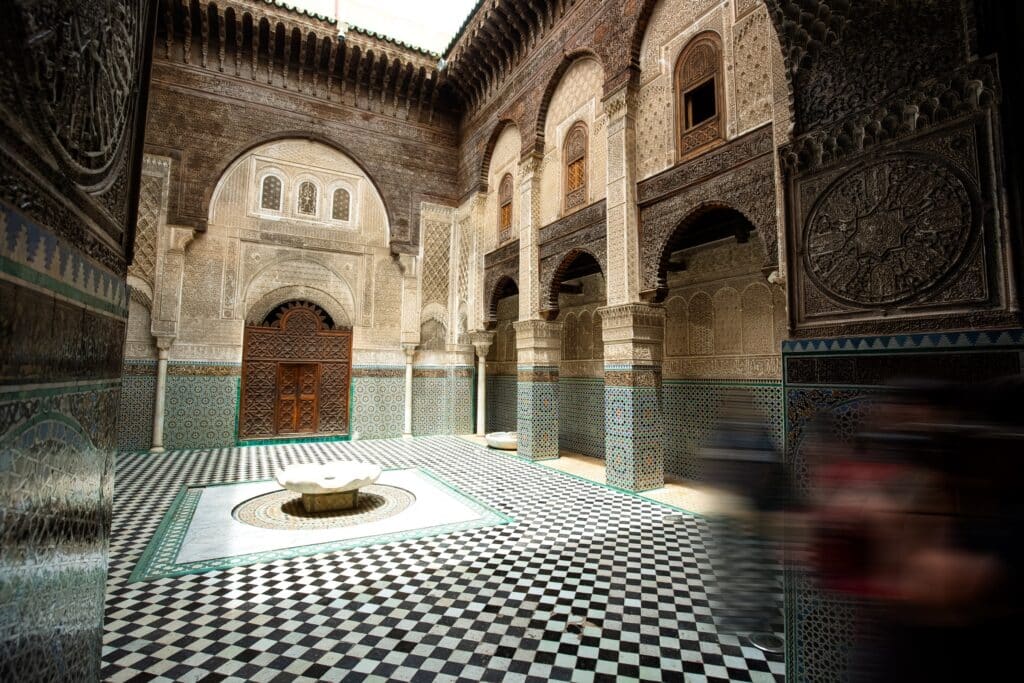
…Push open the door. The courtyard floods the hallway. Forgotten is the medina and the souq, the noise, the heat, and the crowds. Inside, time feels slower and one’s attention sharper…
Fes’s El Attarine madrasa was completed in 1357. It is one of the most compelling architectural examples of space as barzakh. Quranically, barzakh describes a barrier where two seas meet. In ontological terms, the two seas are the two polarities of being — worldliness and divineness. The barzakh is simultaneously the separation and the meeting threshold. Ibn al-Arabi explains: “the sensory thing cannot be a meaning, nor can the meaning be a sensory thing. But the [barzakh] embodies meanings and subtilizes the sensory thing. It transforms the entity of every object of knowledge in the viewer’s eye.”1
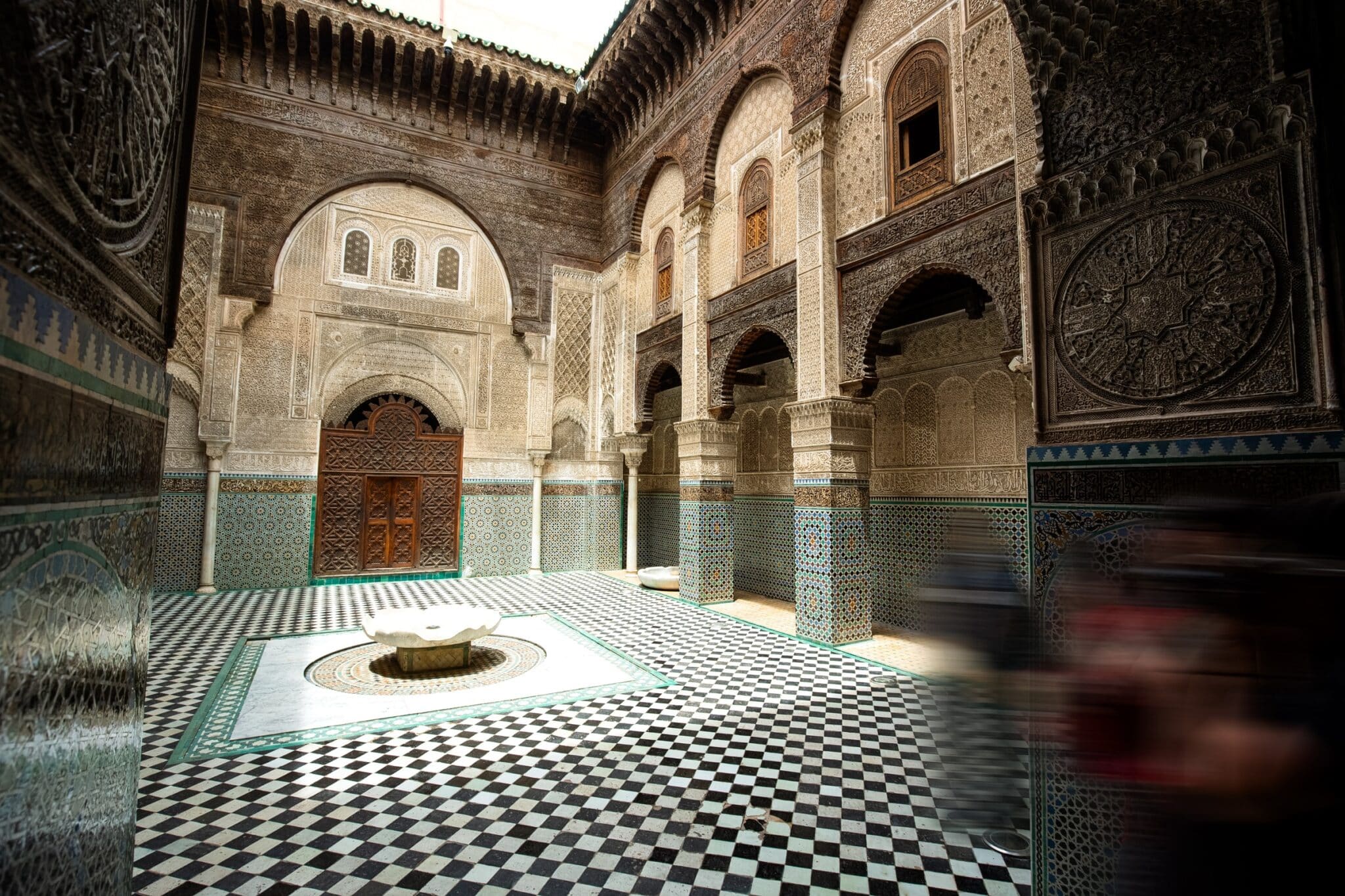
Figure 1: El Attarine Madrasa, Fes, Morocco. Photo by author, 2023.
While the term barzakh can be interpreted as the liminal space between existence and non-existence, it is not limited to a post-mortem realm. Unlike purgatory and bardo, which are by definition transitional and remedial, barzakh is fundamentally concerned with the structure of reality in the here and now. In the writings of Ibn al Arabi, barzakh describes our unique ontological predicament as human beings who are simultaneously of the earth and of God: the clay of Adam and the breath of God, Ruh. Our creations, namely architecture and space, are generative translations of this predicament. As Ibn al Arabi scholar Stephen Hirtenstein suggests in reference to Ibn al Arabi’s analysis of the Kaaba, “the world apparently ‘out there’ [acts] as a mirror that corresponds to and reveals the reality of our own self. In other words, we enter into a direct contemplation of the inner through the outer form.”2 The spaces we create and inhabit can act as portalways of inner contemplation through their outer form. These spaces are disclosures rather than enclosures; they reach beyond their material presence, melding together the spiritual and the sensory, and gesturing toward an unseen.
Barzakh in the Mundane
While El Attarine madrasa deliberately manifests the notion of barzakh, literally enclosing the heavens and bringing them into contact with the earth, barzakh spaces are not limited to these carefully crafted encounters. In the contemporary city, we find these spaces in mundane thresholds, designed and undesigned, where the spaces provoke reflection and contemplation.
Montreal’s Mont Royal offers a compelling example. Frederick Law Olmsted designed the mountain-park as a retreat from the pressures of urban life. The park takes the visitor on a journey from city to nature as they ascend to the summit. Reading the park through the lens of barzakh reveals a new interpretation of Olmstead’s design intent. Mont Royal is a meeting place between city and wilderness; while it is not entirely “city” or entirely “wilderness,” it carries elements of both and, as such, becomes its own entity. On the stairs of Mont Royal, you hear the bustle of the city below while the birds sing in the trees above. The embodied experience of this encounter calls for a moment of inner pause and reflection, registering a shift from the usual maneuvering of the city.
The Montreal metro offers a different kind experience of barzakh. Like Mont Royal, the Metro stations create distinct moments in which the visitor is both within and outside of the city, or more accurately, beneath it. Each of Montreal’s Metro stations is unique in character, but they all share a design intent to underscore and frame their liminal function through materiality and scale. The textured concrete at Pie-IX and Viau, for example, balances between monumentality and tactility, highlighting the grandeur of the space while grounding it in tangibility. These spaces encourage deep inward experience: their sheer size makes you hyperaware of your own being. Outer form prompts a turn inwards. The barzakh experience of the Montreal metro carves moments of pause and reflection that can reveal the cosmological potential of architecture.
Question
While contemporary space is overwhelmingly shaped by capital and spectacle, moments of barzakh are reminders of something different. Architecture shapes how we experience the cosmos and our ontic notions of Being. Barzakh spaces are thresholds where the sensory meets the spiritual, clay meets Ruh, heaven meets earth. These moments are reminders that architecture is not just a backdrop but a fundamental conduit for our understanding of existence. What does it mean to read Ibn al Arabi’s barzakh as a spatial philosophy? How can it affect contemporary architectural thinking? How can we create these types of spaces today?
Notes
1. William C Chittick, The Sufi Path of Knowledge: Ibn al-ʻArabi’s Metaphysics of Imagination (Albany, NY: State University of New York Press, 1989), 123.
2. Stephen Hirtenstein, “The Cubic Wisdom of the Heart According to Ibn ʿArabī,” Journal of the Muhyiddin Ibn ’Arabi Society 48 (2010): 20 .