Mohammadmahdi Zanjanian, Fabian Neuhaus
School of Architecture, Planning and Landscape (SAPL) University of Calgary / Calgary / Canada
mo.zanjanian@ucalagry.ca fabian.neuhaus@ucalgary.ca
Part A: Discussion Circle
Keywords: urbanism, design, theory, meaning, experience, creativity, participatory placemaking
Introduction
Cities are accessible not only when people can physically reach them, but when they can participate in, contribute to, and find meaning within public life. In increasingly individualized urban environments, opportunities for encounter and connection can become as important as physical accessibility. This discussion asks how everyday public spaces might create conditions for meaningful contact: encounters through which people share experiences, exchange knowledge, negotiate differences, and develop relationships.
Drawing on the capability approach (Sen 1985, 1999) and its extension to participatory capabilities (Frediani 2015) and collective capabilities (Ibrahim 2006), the discussion considers participation not simply as a method of consultation, but as a capability that can develop through shared practices. Meaningful contact (Valentine 2008) is central to this process, emerging through encounters in which people share lived experiences and tacit knowledge. Such encounters can transform public space from a setting for movement into a setting for belonging.
Montréal provides a particularly productive setting for exploring this idea. Montréal’s layered histories, cultural plurality, and rich traditions of urban life bring together memory, ritual, and everyday encounters. Montréal therefore becomes not simply the location of the discussion, but a context for reflecting on meaningful contact in everyday urban life.
Conceptual Framework
The discussion uses “meaningful contact” as a lens rather than as a fixed definition. Contact becomes meaningful when an encounter has the potential to transform how people understand one another, cultivating recognition and mutual respect rather than mere tolerance (Valentine 2008). It can emerge through shared practices that draw on lived experience, tacit knowledge, and embodied participation.
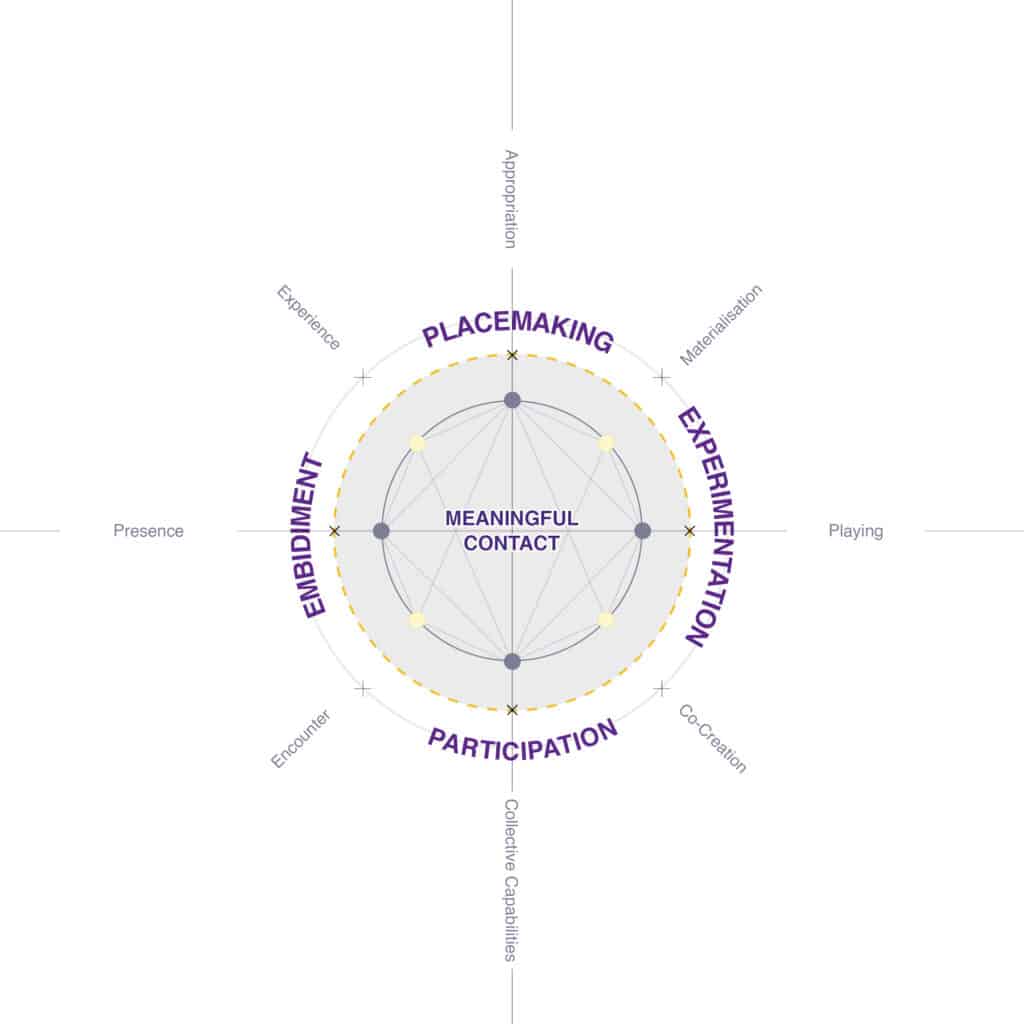
Four interconnected dimensions provide points of entry into this conversation: placemaking, participation, experimentation, and embodiment. Placemaking is understood not simply as producing a physical setting, but as collectively appropriating and giving meaning to space (Courage 2017). Participation extends beyond consultation toward the capacity to contribute, negotiate, and act together (Frediani 2015). Experimentation involves playing, creating, testing, and learning together (Evans, Karvonen, and Raven 2016). Embodiment foregrounds presence, perception, movement, and lived experience as integral to how people encounter places and one another (Seamon 1979).
Together, these dimensions suggest that meaningful contact is produced neither by space alone nor by social interaction alone, but through the relationship between people, practices, and places. This raises a question: how might co-creative interventions bring people together through shared practices—playing, making, gathering, sharing, and experimenting—to create new relationships with one another and with place?
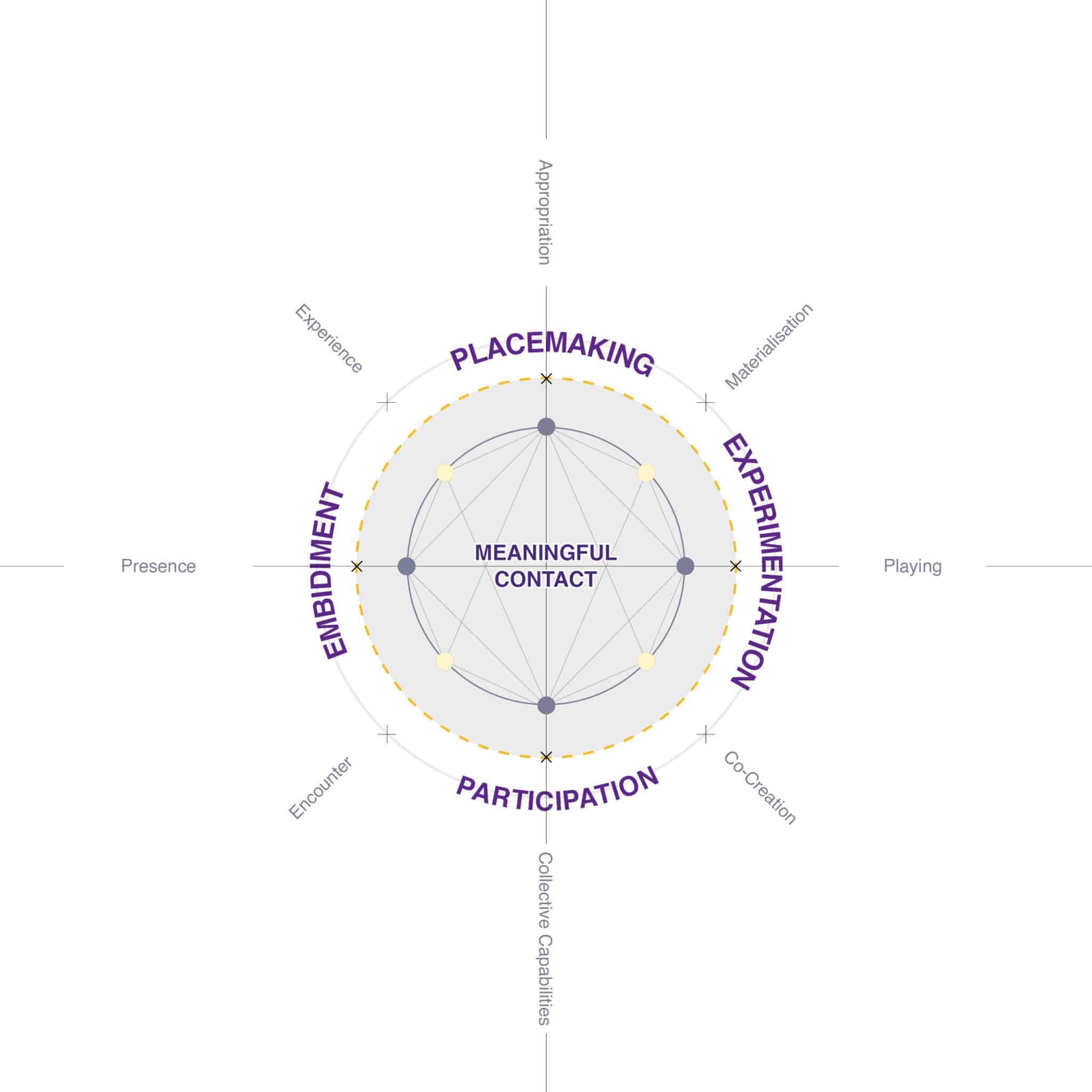
Figure 1: Conceptual Framework. Image credits: Zanjanian and Neuhaus.
The framework conceptualizes meaningful contact as an emergent condition arising through the interaction of four dimensions: placemaking through appropriation, experimentation through playing, creating, and testing, participation through cultivating collective capabilities, and embodiment through presence and lived experience. Their intersections generate processes of materialisation, co-creation, encounter, and experience, through which people can transform relationships with others and with place.
Co-Creative Interventions as Provocation
Two ongoing co-creative initiatives from Calgary—REBLOC and the Pop-Up Kiosk—provide entry points for this conversation. Rather than presenting them as case studies, they illustrate how co-creative interventions can connect people through shared practices and engagements with place, inviting participants to reflect on their own experiences of public space through this framework.
REBLOC is a collaborative board game developed as a co-creative inquiry tool for exploring how participants perceive, negotiate, and respond to urban challenges through collective problem-solving. Through facilitated gameplay, scenario cards, and spatial decision-making, participants articulate values, exchange knowledge, negotiate different perspectives, and imagine alternative urban futures. First tested with SAPL students and faculty, REBLOC was launched publicly at the Calgary Central Library in August 2025 and has since travelled to several Calgary public libraries. These sessions have engaged participants ranging from children to seniors, including recent arrivals and longtime Calgarians. Rather than simply communicating planning knowledge, the game creates a shared setting in which knowledge is produced through interaction and play.
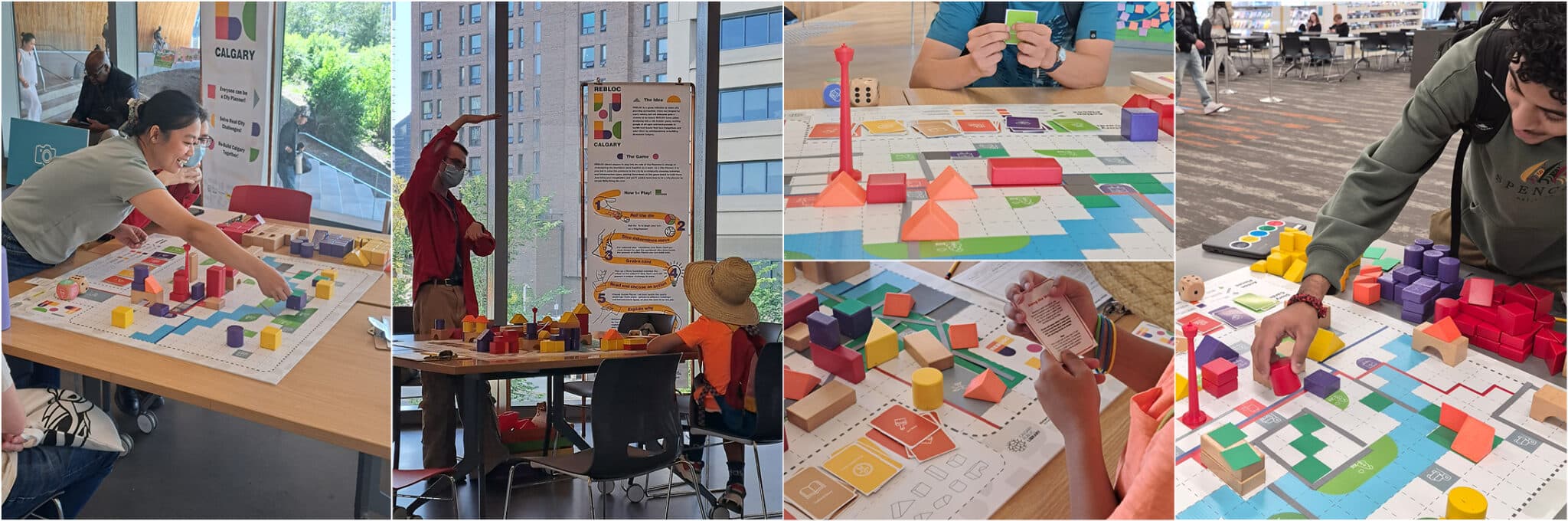
Figure 2: REBLOC board game sessions at Calgary Public Libraries. Image credits: REBLOC project team.
The Pop-Up Kiosk, in turn, is a mobile placemaking platform designed to create temporary conditions for gathering, knowledge exchange, skill-sharing, and creative collaboration. It operates across two interconnected dimensions: a physical dimension, as a mobile structure that enables temporary interventions in public space, and a social dimension, through outreach, social platforms, and ongoing community engagement that connects an expanding network of community knowledge holders and participants. As a flexible platform, it hosts workshops, activities, and other forms of collective making. Here, the physical structure is less important as an object than as an invitation: a visible signal that something can happen here, that people can stop, participate, make, and encounter others.
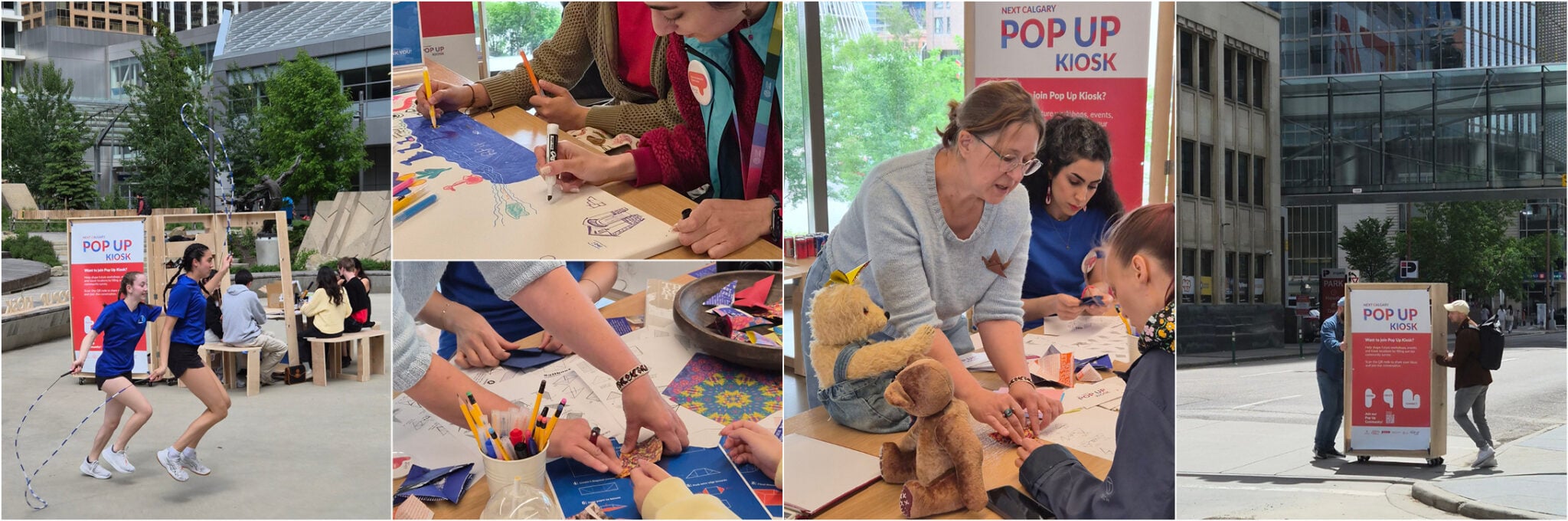
Figure 3: Pop-Up Kiosk sessions at Century Gardens and the Calgary Central Library, June 2026. Image credits: Pop-Up Kiosk project team.
Together, REBLOC and the Pop-Up Kiosk demonstrate two ways in which co-creative interventions can generate meaningful contact: REBLOC uses play to bring participants together to negotiate and imagine urban possibilities, while the Pop-Up Kiosk uses temporary appropriation and collective making to create opportunities to gather, exchange, and experiment together. Both suggest that the social value of an intervention may lie as much in the relationships and experiences it enables as in the physical or intellectual product it produces.
Everyday Urban Ritual
These encounters can also be understood as forms of everyday urban ritual: shared practices through which ordinary places temporarily acquire new meanings. Ritual here does not refer to a predetermined ceremony, but to repeated or spontaneous acts of gathering, making, sharing, watching, playing, remembering, and encountering others. Such practices can make visible the less tangible dimensions of public space—atmosphere, memory, belonging, and collective identity—that the physical city alone cannot fully describe.
An example can be found in Pop-Up Kiosk events at the Calgary Central Library in June 2026, where a local artist facilitated craft activities centered on origami and teddy-bear making. While the activities provided an initial invitation to participate, moments of meaningful contact emerged beyond the act of making itself. For example, a visitor began asking the facilitator about craft techniques, leading to an exchange of knowledge and experiences and, eventually, the sharing of contact information to continue the dialogue beyond the event. These spontaneous interactions transformed a simple craft activity into a moment of knowledge sharing and social connection. In this sense, the ritual does not reside in the craft activity alone, but emerges through the shared practices and relationships that develop around it, temporarily transforming an everyday public setting into a space of collective meaning-making and belonging.
For the Montréal discussion, this example opens up a broader set of questions: What similar moments of unexpected encounter already emerge in Montréal’s everyday public life? What activities, spaces, rituals, memories, or atmospheres make these encounters possible? And when can an ordinary encounter become meaningful enough to reshape how people experience one another and their relationship to place?
Discussion Circle Structure
The first 10 minutes will introduce the concept of meaningful contact through the four dimensions of the conceptual framework—placemaking, participation, experimentation, and embodiment—followed by brief examples from REBLOC and the Pop-Up Kiosk. The notion of everyday urban ritual will then frame the discussion questions. The following 30 minutes will invite participants to share and reflect on their own experiences of encounters in Montréal or other cities, focusing on the relationships between people, practices, and places. The final 5 minutes will briefly introduce a Montréal-adapted version of the REBLOC board game and invite participants to continue the conversation through play.
Part B: Workshop
Mohammadmahdi Zanjanian, Fabian Neuhaus, Craig DeLean, Sophie Symanczyk
School of Architecture, Planning and Landscape (SAPL) University of Calgary / Calgary / Canada
mo.zanjanian@ucalagry.ca fabian.neuhaus@ucalgary.ca craig.delean@ucalgary.ca sophie.symanczyk@ucalgary.ca
Keywords: urbanism, design, meaning, experience, creativity, co-creation, urban games
REBLOC Montréal
Situated within Montréal’s layered civic, cultural, and spiritual landscape, this workshop uses a Montréal-adapted version of REBLOC to explore how collective play, experimentation, and spatial decision-making can create opportunities for meaningful contact.
Participants will work in small groups across three 45 × 45-inch game boards representing downtown Montréal, using dice, story cards, and action pieces. The boards will incorporate selected landmarks and urban landscape connected with the Salon’s sites, such as Old Montréal, MEM, the Metro and Underground City, McGill, and the city’s cultural and sacred spaces.
Story cards will introduce challenges and opportunities drawn from downtown Montréal’s civic memory, cultural life, and everyday urban landscapes, organized around four themes: PLACE (memory and appropriation), PLAY (creation and experimentation), TOGETHER (participation and co-creation), and PRESENCE (encounter and experience). Participants will use the cards and dice to place, move, combine, and negotiate action pieces, collectively imagining how these places might respond to different needs and possibilities.
The workshop can operate as a before-and-after encounter with Montréal. In an initial session, participants will play using their existing knowledge, expectations, and experiences of the city. Following Salon walks, site visits, or other encounters, they can return to the game to revisit, modify, or challenge their earlier decisions. This creates an opportunity to reflect on how embodied experience, new knowledge, and encounters with place reshape perceptions and collective decisions.
References
Courage, Cara. 2017. The Routledge Handbook of Placemaking. London: Routledge.
Evans, James, Andrew Karvonen, and Rob Raven, eds. 2016. The Experimental City. London: Routledge.
Frediani, Alexandre Apsan. 2015. “Participatory Capabilities Approach: Opening Up Alternative Spaces of Transformation.” Progress in Development Studies 15 (1): 41–54.
Ibrahim, Solava. 2006. “From Individual to Collective Capabilities: The Capability Approach as a Conceptual Framework for Human Security.” International Journal of Social Economics 33 (5/6): 322–340.
Klinenberg, Eric. 2018. Palaces for the People: How Social Infrastructure Can Help Fight Inequality, Polarization, and the Decline of Civic Life. New York: Crown.
Pereira, Rafael H. M., and André Herszenhut. 2023. Introduction to Urban Accessibility: A Practical Guide with R. New York: Transport Research Board.
Seamon, David. 1979. A Geography of the Lifeworld: Movement, Rest and Encounter. London: Croom Helm.
Sen, Amartya. 1985. Commodities and Capabilities. Amsterdam: North-Holland.
Sen, Amartya. 1999. Development as Freedom. New York: Alfred A. Knopf.
Turkle, Sherry. 2011. Alone Together: Why We Expect More from Technology and Less from Each Other. New York: Basic Books.
Valentine, Gill. 2008. “Living with Difference: Reflections on Geographies of Encounter.” Progress in Human Geography 32 (3): 323–337.
Acknowledgements
REBLOC Project
Principal Investigator
Dr. Fabian Neuhaus, Associate Professor, School of Architecture, Planning and Landscape (SAPL)
Advisor
Dr. Sandra Abegglen, Postdoctoral Candidate, Werklund School of Education
Project Lead
Mohammadmahdi Zanjanian, PhD Student, Environmental Design, SAPL
Graduate Research Assistants (SAPL)
Craig DeLean, Master of Planning
Sophie Symanczyk, Master of Landscape Architecture
Bridgette Crabbe, Master of Planning
Calgary Public Library
Heather Robertson, Steven Dohlman, Michaela Ritchie (Central)
Ethan Cole, Isobel Rancier (Village Square)
Mary Graham, Naghmeh Dadgar-Azad (Skyview)
The Federation of Calgary Communities
Adam Schwartz
Volunteers
Fatemeh Saed (Photography and Event Support)
Sepehr Younesnejad (3D Printing Support)
Pop-Up Kiosk Project
Principal Investigator
Dr. Fabian Neuhaus, Associate Professor, School of Architecture, Planning and Landscape (SAPL)
Project Leads
Sven Kohlschmidt, Planner, urbanista
Mohammadmahdi Zanjanian, PhD student, Environmental Design, SAPL
Graduate Research Assistants (SAPL)
Sepher Younesnejad, Master of Architecture
Maddy Lamb, BDCI Student
Daniel Snell, BDCI Student
Craig DeLean, Master of Planning
Sophie Symanczyk, Master of Landscape Architecture
Molly Kent, Master of Architecture
Community Contributors:
Skip Time Calgary
Oxana Layshenko
Raha Jazayeri
Volunteers:
Fatemeh Saed (Photography and Event Support)
Ghazal Ebrahimi (Event Support)
Support
Richard Parker Initiative
NextCalgary
Calgary Public Library
School of Architecture, Planning and Landscape