Olga Cuxart Oriol
Independent Artist-Scholar (Spain)
ocuxarto@gmail.com
Abstract
This paper investigates how contemporary sculpture contributes to spiritual reflection, ritual engagement, and symbolic place-making. It explores the medium as a dynamic dialogue between material form and ecological perception. Combining cross-cultural case studies and theoretical perspectives, it presents sculpture as a perceptual and narrative practice—activating memory, marking symbolic thresholds, and sustaining embodied traditions. The aim is to complement architectural and spiritual discourses by positioning sculpture as an agent of transformation in space.

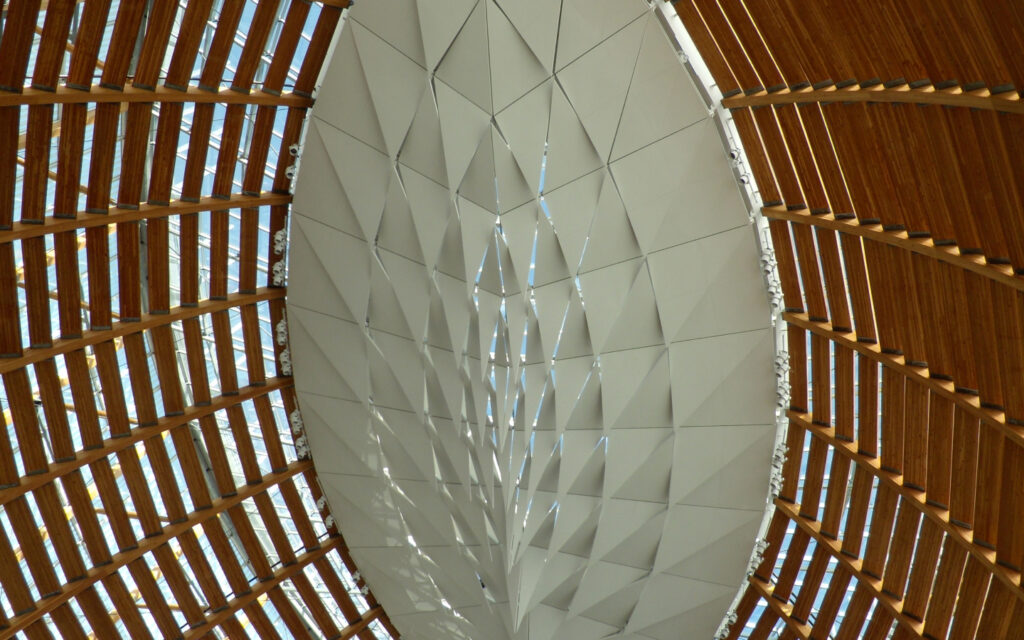
Fig. 1. Contemporary symbolic sculpture evoking spatial cosmology in stone. (artist unknown)
Introduction
The main objective of this study is to examine how sculptural practices enrich the cultural and spiritual significance of place by highlighting the importance of materiality, visual culture, and ritual continuity. Rather than focusing on gaps in the existing literature, this work expands current scholarship by combining theoretical analysis with practice-based research supported by the author’s direct engagement in site-responsive sculptural practice. The discussion uses case studies to illustrate how this medium bridges tradition and transformation, reconnecting the sacred and the everyday through diverse mythic geographies.
Theoretical Framework
This approach considers sculpture not merely as an art object, but as a spatial and semiotic medium situated at the intersection of ritual studies, environmental theory, and material culture. Drawing on phenomenology and ecological aesthetics, it examines this artistic practice as an environmentally and relationally oriented field. Through “Material Mythologies,” sculpture reveals how cultural beliefs and ritual worldviews are embedded in matter—transforming stone, bronze, or clay into sensorial carriers of intangible meaning. The term “Material Mythologies” is employed here to describe the intersection between material culture, archetypal patterns, and mythic imagination in contemporary sculpture. These immersive environments transcend matter and form, engaging multisensory perception through sound, light, shadow, and emotion, and suggesting a phenomenological experience that is at once symbolic and transformative.

Fig. 2. James Turrell, Crater’s Eye East Portal, Roden Crater, Arizona (1977-). Skystone Foundation, rodencrater.com
Unlike architecture, which often relies on containment and permanence, this medium operates through orientation, materiality, and perceptual thresholds, serving both as an object and as an environment that condenses meaning and invites ceremonial engagement. Frequently drawing on principles of sacred geometry, sculpture employs proportions and spatial alignments to evoke harmony. Its scale, tactility, and site-responsiveness make it particularly suited to articulating liminal spaces where myth and reality intersect.
As Juhani Pallasmaa states in The Eyes of the Skin, architecture and sculpture meet when the plastic volume functions not as shelter but as a spatial proposition—a tension field between body, matter, and orientation. Other key references in this paper support this view: Carol Duncan’s Civilizing Rituals develops the idea of the museum as ritual environment; Tomoko Masuzawa’s The Invention of World Religions explores the construction of pluralistic religiosity through the notion of secular pilgrimage, tracing how modern experiences of meaning often mirror ritual structures outside religious frameworks; and Miwon Kwon’s One Place After Another highlights participation and displacement in site-specific art. Developing from Kwon’s ideas of viewer participation in public art—spaces that foster embodied engagement—Chillida-Leku stands as a notable example where monumental works merge with the landscape, exemplifying how such environments foster contemplation, meditative presence, and spatial awareness beyond conventional art institutions.
Case Studies
To begin with, one iconic example is The Thinker by Auguste Rodin. Conceived in 1880 and cast in multiple versions from 1904 onward, the work was initially part of The Gates of Hell, inspired by Dante’s Divine Comedy (1320). Originally titled The Poet, it depicted Dante contemplating the torments of the underworld. Over time, the piece detached from its original narrative and became a global icon of intellectual struggle. Replicated in over twenty cities, it has transformed civic spaces into sites of contemplation. Its evolution from literary figure to secular monument demonstrates how this medium acquires ritual significance through repetition and emplacement. Though not sacred by design, its reception invites communal attention, turning it into a modern myth of knowledge, solitude, and the human condition.
A different way of relating to space can be found in James Turrell’s Roden Crater in Arizona, a land art project continuously developed since 1977 that transforms the landscape into a celestial instrument. Evoking ancient sky temples, Turrell’s work engages light, shadow, color perception, and spatial orientation in ways that invite both cosmological and meditative reflection. Similarly, Richard Serra’s East-West/West-East, located in the Qatari desert, operates as a minimalist sculptural installation that encourages spatial awareness and embodied movement within a vast horizontal landscape. Both projects reflect the use of sculpture not as object alone, but as an instrument of orientation and perceptual framing.

Fig. 3. Cristina Iglesias, Tres Aguas, Town Hall, detail. Toledo, 2014. © VEGAP
Memory and ritual are also articulated through sculptural topographies, as seen in Maya Lin’s Vietnam Veterans Memorial. With its minimalist form and engraved names, the work becomes a space for grief and quiet reflection, inviting visitors to engage physically and emotionally with loss. Cristina Iglesias, with a complementary perspective grounded in myth and material presence, created Tres Aguas, which reactivates subterranean water systems through sculptural installations that integrate architecture, myth, and the ritual presence of water in all its dimensions. Her multisensory staging, combining metal, water, and silence, transforms public spaces into a uniquely contemplative experience. In a similar spirit, Gateway to the Earth presents a site-specific triangular threshold developed in East Asia. While referencing sacred geometry and symbolic passage, the work emphasizes material presence, seasonal transition, and embodied perception. Constructed using local bamboo, it invites contemplative movement and situates myth within the relational dynamics of place. Its more intimate scale contrasts with monumental land art, offering a participatory encounter grounded in ecological and spatial awareness.

Fig. 4. © Olga Cuxart, Gateway to the Earth, Yancheng, China. 2025
The final case examined shifts focus from individual artistic authorship to collective production. On the eastern coast of China, the city of Hui’an offers an example where sculpture serves as both spiritual language and cultural economy. Known for its longstanding tradition of stone carving, Hui’an has become a global hub for the production of sacred monumental works. Local workshops produce large-scale statuary—Buddhas, bodhisattvas, ancestral monuments, and funerary steles—for temples across Asia and for international export. Despite the industrial scale of production, traditional techniques are transmitted from master to apprentice, preserving intergenerational craft knowledge. The fusion of local heritage and global circulation positions Hui’an as a site of both cultural preservation and contemporary adaptation. This case exemplifies how place-based craftsmanship sustains symbolic languages across borders, with stone functioning as a carrier of spiritual iconography that links material, legacy, and myth. These practices resonate with decolonial aesthetics, re-centering ritual and material knowledge beyond Western paradigms of meaning and form.
Thus, collectively examined, all these works shape meaning across scales—from civic landmarks to immersive landscapes. As Peter Zumthor suggests in Thinking Architecture, materials are not inert: they speak. Their sensory qualities shape how we relate to space, time, and the sacred. Building on this, sculpture becomes a medium not only of form but of resonance, contributing to contemporary conversations about art, myth, and spatial experience.
Conclusion
This paper positions sculpture as a vital element of contemporary spatial practices. Focusing on embodied perception, ecological awareness, and metaphorical thresholds, it redefines the sculptural medium as an agent of cultural and spiritual place-making. When situated in space and connected to time, belief, and memory, sculpture becomes a participatory site where myth and environment intersect.
Contemporary works increasingly foster sensory immersion, bringing sculptural practice into closer dialogue with architecture. While not yet conceived as permanent habitats, these installations generate experiential zones that shape how public spaces are perceived and used. This trend suggests a growing role for sculpture in reimagining the built world.
Ultimately, through its capacity to condense myth, evoke ritual, and animate perception, sculpture enables a renewed understanding of place—as something both sense and signified. It emerges as a material vocabulary of the sacred shaping how communities engage with space and envision future environments.
References
- Alighieri, Dante. The Divine Comedy. New York: Modern Library, 2000.
- Chillida-Leku Museum, Hernani, Spain. Accessed May 28, 2025. https://museochillidaleku.com.
- Cuxart, Olga. Gateway to the Earth. 2025. Bamboo, wood, and metal. Site-specific sculpture, Yancheng, China.
- Duncan, Carol. Civilizing Rituals: Inside Public Art Museums. London: Routledge, 1995.
- Iglesias, Cristina. Tres Aguas. 2014. Mixed media, public installation, Toledo, Spain. Accessed May 30, 2025. https://cristinaiglesias.com.
- Kwon, Miwon. One Place After Another: Site-Specific Art and Locational Identity. Cambridge, MA: MIT Press, 2002.
- Lin, Maya. Vietnam Veterans Memorial. 1982. Black granite, Washington, DC.
- Masuzawa, Tomoko. The Invention of World Religions: Or, How European Universalism Was Preserved in the Language of Pluralism. Chicago: University of Chicago Press, 2005.
- Pallasmaa, Juhani. The Eyes of the Skin: Architecture and the Senses. Chichester: John Wiley & Sons, 1996.
- Rodin, Auguste. The Thinker. Original cast 1904. Bronze, Musée Rodin, Paris.
- Serra, Richard. East-West/West-East. 2014. Steel installation, Brouq Nature Reserve, Qatar.
- Turrell, James. Roden Crater. An ongoing project since the 1970s. Painted Desert, Arizona. Accessed May 28, 2025. https://rodencrater.com.Zumthor, Peter. Thinking Architecture. 2nd ed. Basel: Birkhäuser, 2006