Jyoti Pandey Sharma
Department of Architecture, School of Planning and Architecture New Delhi, New Delhi, India
jyoti.pandey.sharma@spa.ac.in
Introduction
Drawing on Eliade’s contention that the myth is a hierophany, i.e., a manifestation of the sacred that humans rely on to make sense of their world, I explore its dialogical intersectionality with persona, circumstance, place and physical setting i.e., the built environment.(1) I specifically explore how the built-environment supports myth generation, its appeal and endurance to produce a narrative of the sacred history of a place. I propose that the built environment does not compete with the myth as an equal partner via architectural grandstanding, rather it remains in the backdrop as an unassuming spatial receptacle where the myth, the bigger partner in the relationship, resides and where its role as a bridge between the divine realm and the everyday material world is nurtured. I unpack the built environment’s historical, cultural and spiritual layers to show how myths transform modest structures into something bigger and enduring.
To make my argument, I turn to medieval Delhi’s Sufi(2) landscape with over seven centuries of an uninterrupted tradition of piety and pilgrimage grounded in folklore that is centred on the Dargah, the place of interment of a Sufi. Among Delhi’s many Sufis, I focus on Hazrat Nizamuddin Auliya (1238-1325) and his Dargah, a site revered by pilgrims since centuries who seek his Barakat (blessing) and enact rituals that are grounded in the site’s sacred history.(3) This history is revealed by a compendium of myths that have since centuries fashioned the worldview of the resident community, pilgrims and the city of Delhi at large. The Dargah precinct, home to these myths, has a large concentration of medieval era architectural remains, comprising tombs most notably that of Hazrat Nizamuddin Auliya; imperial, sub-imperial and plebeian graves; pavilions; courtyards; and water structures including wells and Baolis (stepwells).(4) This historic compendium is not merely a physical artefact but is a crucible where myths were born, perpetuated and continue to have relevance to this day. Amidst this architectural setting of Delhi’s Sufi landscape, where many myths reside, I focus on the dialogical relationship between one specific type of water structure, the Baoli, that forms a vital part of medieval Delhi’s hydro-scape and the myths associated with it.(5)
Delhi’s Baolis
Medieval Delhi was climatically a semi-arid region and both its Muslim rulers and Sufis patronized water structures to produce a hydro-scape replete with Nahrs (canals), Talaos (ponds), Jheels (lakes), Jharnas (cascades), Hauzs (tanks/reservoirs), Chahs (well) and Baolis. The Baoli, the subject of my investigation, played multiple roles, it sustained life, forged socio-cultural relationships and also had a religious and sacred dimension. The rulers’ patronage of Baolis was driven by practicality, while for the Sufis, the Baoli, forming an integral part of their Khanqah (seminary), transcended its utilitarianism to embody the Sufi’s Barakat. Indeed, each Sufi built a Baoli exclusively within his Khanqah and Baolis were rarely shared among the saintly brotherhood.(6)
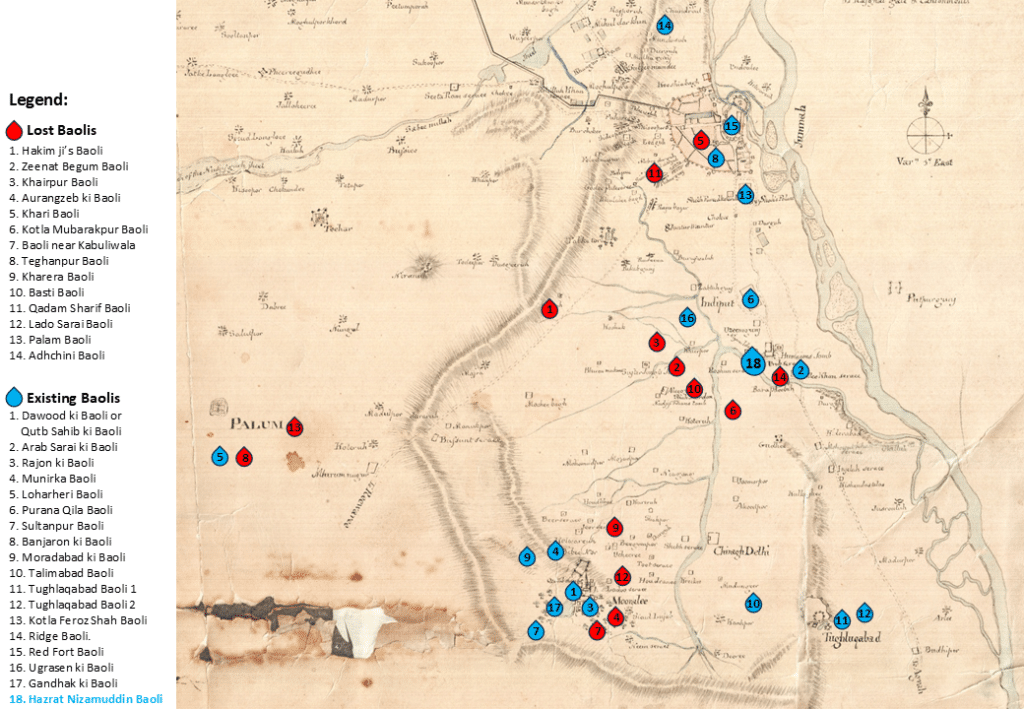
Figure 1: Map of the Delhi Region in 1807 with all existing and lost Baolis marked. (Map courtesy: National Archives of India, Folio:183, Sheet:24. Baolis marked by Kirti Gupta, PhD Scholar, Department of Architecture, School of Planning and Architecture New Delhi).
The Mythical Origin of Hazrat Nizamuddin Auliya’s Baoli
Among the several Baolis in Delhi, I focus on the one built by Hazrat Nizamuddin Auliya in his Khanqah-later-turned-Dargah and explore the relationship between it – an architecturally unassuming structure – and the myths that surround it. A reading of archival and contemporary sources reveals that the Baoli and the myths are entangled in a complex relationship.(7) To begin with, the building of the Baoli has been immortalized by tales of a clash between the throne (represented by the incumbent ruler of Delhi, Sultan Ghias-ud din Tughlak (r.1320-1325)) and the pulpit (represented by Hazrat Nizamuddin Auliya), where the former – driven by his jealously of the Sufi’s popularity – took recourse to measures to stop the building of the Baoli. However, the latter’s piety overcame all obstacles and ensured its completion but not before Hazrat Nizamuddin Auliya cursed the ruler. Pronouncing ‘Hunuz, Dilli duur ast’ i.e., Delhi is still far away, the ruler who was making his way back to Delhi, died before he could enter the city, thus establishing in the public imagination the efficacy of the Sufi’s curse for all times to come. In fact, the mythical curse crossed boundaries to became a phrase of everyday use as explained in the concluding remarks.

Figure 2: Plan and Section of Hazrat Nizamuddin Baoli. (Courtesy: Aga Khan Trust for Culture, New Delhi).
The Baoli’s Built Environment
An architectural analysis of the Baoli reveals that it was a modest structure located within the Khanqah-turned Dargah and was linked to it via a passage.(8) Built of locally available Delhi quartzite, it had a walled enclosure with a flight of steps leading to the circular well. Over time, it was enclosed by an assortment of structures including tombs, pavilions and dwellings. Stylistically speaking, the Baoli was akin to the other Baolis of the city, a functional water structure that was largely devoid of ornamentation and whose primary purpose was to give access to water. Indeed, the Baoli epitomized its patron’s simple and austere life by avoiding overt grandstanding, but it departed from the other Delhi Baolis. Not only did it allow the myth of its construction to acquire a larger than life dimension, its water manifested Eliade’s hierophany as it was and continues to be regarded as Karamati (miraculous) by pilgrims who partake of it as part of Hazrat Nizamuddin Auliya’s Barakat. Folklore has it that the Sufi blessed the water of the Baoli’s well during the course of its construction – that the Tughlak Sultan endeavoured to stall – and its water acquired the properties of oil. This facilitated unhindered construction work of the Baoli at night under the light of water-turned-oil lamps. Thereafter, the Baoli’s water was believed to hold potential to ward off all forms of evil and to cure illnesses of the body and of the mind. This Karamati Baoli and its equally Karamati water began to draw the Dargah’s pilgrims who had unshakeable faith in this folklore. They negotiated this myth via a series of ritualistic actions performed at the Baoli, a practice that has continued uninterrupted since the fourteenth century.

Figure 3: Model of the Nizamuddin Dargah complex showing the relationship of the Baoli to its environs. (Courtesy: Aga Khan Trust for Culture, New Delhi).

Figure 4: Aerial view of the Baoli and its dense historic urban setting. (Courtesy: Aga Khan Trust for Culture, New Delhi).
Conclusion
I have demonstrated that the layered intersection of persona, circumstance, place and setting enabled Hazrat Nizamuddin Auliya’s Baoli, an architecturally modest structure, to transform into a Karamati entity via its construction history and also hold water that transformed into a miraculous healing agent, thereby becoming a repository of the Dargah’s sacred history. Through centuries, pilgrims have engaged with the Baoli by enacting rituals like diving in its water; standing in it; sipping it or simply standing on its edge to offer a silent prayer, thus keeping the myth alive, in the midst of transforming politico-cultural circumstances. Even as years of neglect caused the Baoli to silt; its precinct was encroached and there was a partial collapse in 2008, the power of its water’s curative prowess, a divine attribute, took precedence over its material contamination. Indeed, the decrepit Baoli’s appeal lay in its mythical past with its worn out physical fabric hardly denting the pilgrim’s faith. Such is the appeal and endurance of the myth.

Figure 5: Conservation Intervention on the Baoli showing the Before (left) and After (right) scenarios. (Courtesy: Aga Khan Trust for Culture, New Delhi).
Meanwhile, the Baoli’s restoration was initiated in 2008 as part of the larger urban renewal project for the area whose predominant constituent was the Dargah complex in its entirety. The programme adopted a synergistic approach where the Basti (implying neighbourhood in simplistic terms) residents, urban local body, government departments and non-government organizations including international agencies worked together.(9) Specifically for the Baoli, a scientific investigation based community led endeavour came to underlie its restoration. The local community rendered assistance through Shramdaan (voluntary labour) for activities like debris clearance, de-silting of the well and general cleanliness of the environs.
Additionally, Hazrat Nizamuddin Auliya’s pronouncement ‘Hunuz, Dilli duur ast’, immortalized as part of the Dargah’s folklore, has made its way into contemporary vocabulary as Abhi Dilli Door Hai (Delhi is still far away) to imply, in matters more worldly than spiritual, that there is many a slip between the cup and the lip. This seamless integration of the phrase into the present everyday demonstrates the endurance and the power of the myth. I end by underscoring the need for recognizing and mainstreaming the narrative of the myth as essential for a holistic comprehension of the built environment.
Footnotes
- Eliade, Mircea. Myths, Dreams and Mysteries: The Encounter Between Contemporary Faiths and Archaic Realities. (Trans.). Philip Mairet. New York: Harper Torchbooks, 1960.
- Sufism is a mystic form of Islam and its practitioner is a Sufi meaning Saint. See, Rizvi, Saiyid Athar Abbas. A History of Sufism in India. New Delhi: Munshiram Manoharlal, 1978.
- Nizami, Khaliq Ahmad. The Life and Times of Shaikh Nizam-u’d-din Auliya. New Delhi: Oxford University Press, 2007.
- Dehlvi, Sadia. The Sufi Courtyard: Dargahs of Delhi. New Delhi: Harper Collins, 2012. For an account of the Dargah of Hazrat Nizamuddin Auliya, see, Pinto, Desirerio. The Mystery of the Nizamuddin Dargah: The Accounts of Pilgrims in Troll, Christian W. (ed.). Muslim Shrines in India: Their Character, History and Significance. New Delhi: Oxford University Press, 1989 and Pinto, Desiderio. Piri-muridi Relationship: A Study of the Nizamuddin Dargah. New Delhi: Manohar, 1995. For an architectural perspective, see, Hasan, Maulvi Zafar. Memoirs of the Archaeological Survey of India: No. 10 – A Guide to Nizamu-d Din. Calcutta: Superintendent Government Printing, 1922.
- The Baoli is a water structure that originated in the Indian subcontinent prior to Muslim rule. It was built in semi-arid and arid regions to cater to the need for water. However, it’s design went beyond the utilitarian to provide an aesthetically pleasing space for leisure where the descent to the water level was via a long flight of steps that opened into airy pavilions and interconnected galleries along its sides. These leisure spaces were used specially during the hot summer months as they offered a cool respite. In terms of patronage, Baolis were built by the elite for personal use as well as for charity as public infrastructure. Baolis where both men and women came together for leisure tended to be private or semi-private, while those built for the public at large often had a gendered use with groups of women visiting the Baoli to fetch water from the well and for social interaction. It is quite plausible that each caste built its own Baoli in service to their respective community. The most spectacular Baolis were built in mediaeval Gujarat and Rajasthan. In comparison, those built in mediaeval Delhi are austere. For a general discussion on the Baolis of Delhi, see, Rooprai, Vikramjit Singh. Delhi Heritage: Top Ten Baolis. Delhi: Niyogi books, 2019.
- Ibid.
- The following account is primarily drawn from Hasan, Guide.
- The analysis is based on a critical reading of the Baoli’s visual material, both archival and contemporary, as well as on fieldwork undertaken from 2001 to 2025.
- For a detailed description of the project, see, Aga Khan Trust for Culture. Conservation of the Baoli. Nizamuddin Urban Renewal Initiative. <http://www.nizamuddinrenewal.org> accessed latest on 21 June 2025.